Sunday, 6 September 2015

Du’aa Too Is a Form Of Worship.


Du’aa Too Is a Form Of Worship.

[ Allah’s Messenger (sallallahu alaihi wa-sallam) said: “Du’aa (supplication) is worship.” Then he recited: ‘And your Rabb (Lord) says: ‘Call on Me, I will answer your prayer.’” [Sunan Abu Dawood (Eng. Trans.) vol.1, p.387, no.1474., Imaam al-Bukhare in al-Adab al-Mufrad (714), at-Tirmidhi vol. 4, no.178 - 223), Ibn Majah vol. 2, no. 428-9), and Musnad Ahmad vol.4, no.267-271-276-277 and others. See Saheeh Sunan Abu Dawood vol. 1, no.1312.]

Therefore, to visit graves to make Du’aa for oneself believing that Du’aa is more acceptable at the graves of the righteous is also taking graves as places of worship.

Share: Du’aa Too Is a Form Of Worship.

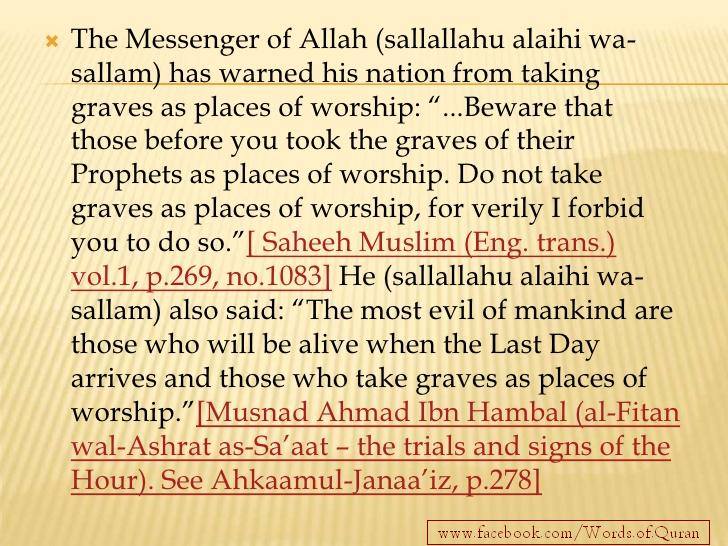
The Messenger of Allah (sallallahu alaihi wa-sallam) has warned his nation from taking graves as places of worship:


The Messenger of Allah (sallallahu alaihi wa-sallam) has warned his nation from taking graves as places of worship:

 “...Beware that those before you took the graves of their Prophets as places of worship. Do not take graves as places of worship, for verily I forbid you to do so.

”[ Saheeh Muslim (Eng. trans.) vol.1, p.269, no.1083] He (sallallahu alaihi wa-sallam) also said: “The most evil of mankind are those who will be alive when the Last Day arrives and those who take graves as places of worship.”[Musnad Ahmad Ibn Hambal (al-Fitan wal-Ashrat as-Sa’aat – the trials and signs of the Hour). See Ahkaamul-Janaa’iz, p.278]

Share: The Messenger of Allah (sallallahu alaihi wa-sallam) has warned his nation from taking graves as places of worship:

ALLAH GAVE IBRAHIM ISHAQ AND YA`QUB


ALLAH GAVE IBRAHIM ISHAQ AND YA`QUB  

Allah, the Exalted, says that when the Friend of Allah (Ibrahim) withdrew from his father and his people for the sake of Allah, Allah gave him in exchange those who were better than them. He gave him Ishaq (Isaac) and Ya`qub (Jacob), meaning his son, Ishaq, and Ishaq's son, Ya`qub. This is as Allah said in another Ayah,

Surah Al-Anbiya, Verse 72:
وَوَهَبْنَا لَهُ إِسْحَاقَ وَيَعْقُوبَ نَافِلَةً وَكُلًّا جَعَلْنَا صَالِحِينَ
And We bestowed upon him Ishâque (Isaac), and (a grandson) Ya'qûb (Jacob). Each one We made righteous.

Also, Allah says,

Surah Hud, Verse 71:
وَامْرَأَتُهُ قَائِمَةٌ فَضَحِكَتْ فَبَشَّرْنَاهَا بِإِسْحَاقَ وَمِن وَرَاءِ إِسْحَاقَ يَعْقُوبَ

And his wife was standing (by), so she laughed, then We gave her the good news of Ishaq and after Ishaq of (a son's son) Yaqoub.

 There is no difference of opinion about Ishaq being the father of Ya`qub. This is what is recorded in the Qur'an in Surah Al-Baqarah.

Surah Al-Baqara, Verse 133:
أَمْ كُنتُمْ شُهَدَاءَ إِذْ حَضَرَ يَعْقُوبَ الْمَوْتُ إِذْ قَالَ لِبَنِيهِ مَا تَعْبُدُونَ مِن بَعْدِي قَالُوا نَعْبُدُ إِلَٰهَكَ وَإِلَٰهَ آبَائِكَ إِبْرَاهِيمَ وَإِسْمَاعِيلَ وَإِسْحَاقَ إِلَٰهًا وَاحِدًا وَنَحْنُ لَهُ مُسْلِمُونَ
Or were you witnesses when death approached Ya`qub When he said unto his sons, "What will you worship after me" They said, "We shall worship your God the God of your fathers, Ibrahim, Isma`il and Ishaq.

Allah only mentioned Ishaq and Ya`qub here to show that He made Prophets from among his descendants and successors in order to give him relief and happiness in his life. This is why Allah says,

Surah Maryam, Verse 49:
فَلَمَّا اعْتَزَلَهُمْ وَمَا يَعْبُدُونَ مِن دُونِ اللَّهِ وَهَبْنَا لَهُ إِسْحَاقَ وَيَعْقُوبَ وَكُلًّا جَعَلْنَا نَبِيًّا
So when he withdrew from them and what they worshipped besides Allah, We gave to him Ishaq and Yaqoub, and each one of them We made a prophet.

If Ya`qub had not become a Prophet in the lifetime of Ibrahim, then Allah would not have limited the promise of prophethood to him, but He would have mentioned his son Yusuf as well. For verily, Yusuf was also a Prophet, just as the Messenger of Allah said in a Hadith whose authenticity is agreed upon, when he was asked who was the best of people. He said,

(The Prophet of Allah, Yusuf, the son of the Prophet of Allah Ya`qub, the son of the Prophet of Allah Ishaq, the son of the Friend of Allah Ibrahim.) In another wording of this Hadith, he said,

(Verily, the noble one is the son of the noble one, who is the son of the noble one, who is the son of the noble one. That is Yusuf, the son of Ya`qub, the son of Ishaq, the son of Ibrahim.) Concerning Allah's statement,

(And We gave them of Our mercy, and We granted Sidqin `Aliyyan on the tongues. ) `Ali bin Abi Talhah reported that Ibn `Abbas said, "Sidqin `Aliyyan means the good praise.'' As-Suddi and Malik bin Anas said the same thing. Ibn Jarir said, "Allah only said `Aliyyan (loftiness, exalted) because all of the religions commend them and mention them with praises, may Allah's peace and blessing be upon them all.''

Surah Maryam, Verse 51:
وَاذْكُرْ فِي الْكِتَابِ مُوسَىٰ إِنَّهُ كَانَ مُخْلَصًا وَكَانَ رَسُولًا نَّبِيًّا
 And mention in the Book, Musa. Verily, he was Mukhlasan and he was a Messenger, (and) a Prophet.

Surah Maryam, Verse 52:
وَنَادَيْنَاهُ مِن جَانِبِ الطُّورِ الْأَيْمَنِ وَقَرَّبْنَاهُ نَجِيًّا
And We called him from the right side of the Mount (Tur), and made him draw near to Us for a talk with him.

Surah Maryam, Verse 53:
وَوَهَبْنَا لَهُ مِن رَّحْمَتِنَا أَخَاهُ هَارُونَ نَبِيًّا
And We granted him his brother Harun, (also) a Prophet, out of Our mercy.)

Share: ALLAH GAVE IBRAHIM ISHAQ AND YA`QUB

The States of Hardship and Goodness


The States of Hardship and Goodness
==================================

“And if Allah should touch you with adversity, there is no remover of it except Him; and if He intends good for you, then there is none who can repel His Favour.

He causes it to reach whom He wills of His servants.

And He is the Forgiving, the Merciful.” [Yunus: 107]

There are 2 states that every single living thing goes through in life: times of hardship and times of bounty.

 There’ll be days where you struggle, and there’ll be days when you rejoice and are happy.

 They exist so there’s no point in denying them, neither for yourself nor for others. But in the verse above, Allah makes it clear that these states run according to His Mashee’ah (Will), and the verbs He uses for them really help us understand the way He works:

When it comes to adversity and trials, He uses the verb ‘yamsaska’ (from the root massa) which means ‘to touch’.

This gives you the idea that trials on this earth merely just ‘touch’ a person.

They will come but they will also quickly go, because a touch never stays. Also, when you touch a person on the shoulder for example, you are usually alerting them or trying to get their attention, and it’s always done out of concern or love.

This is how we should view the tests of Allah, when they come to a person (and to Allah is the Highest example).

In the next part, Allah says ‘and if He intends good for you’… He doesn’t use the term ‘touch’ here, but rather one of intention.

 Whoever knows His Lord will be so happy at reading this part because there is none who fulfills His Promise as much as Allah does.

His intention and iradah *is* His Decree and His Promise, and once He intends good for you, there is nobody, absolutely nobody that can take it away from you, try as they may, strive as they wish.

Both these states of hardship and goodness are directed to every slave of Allah and this is why He says afterwards: ‘Yuseebu bihi’ (causes it to reach) – i.e. it’s like a spear or targeted arrow which never misses the spot.

 We usually associate this example with bad things, but we never think about how it also relates to good things.

When the khayr (good) is directed at you, it will never miss you, so don’t think that your life is bereft of good stuff when all it takes is one intent from Allah and before you know it, His bounties are poured over you.

But if you must struggle in your life, then realise it will merely be like a touch before it is lifted from you, so in both cases, rejoice and take delight in the beautiful way that Allah works in our lives.

Allahu Akbar!

Share: The States of Hardship and Goodness

No one is born racist


No one is born racist
==========================
Hindu's blood and Muslim's blood
==========================
Islam puts an end to Racism, No Racism in Islam
- Malcolm X
==========================
America and the world need to understand Islam
- Malcolm X
==========================
“America needs to understand Islam, because this is the one religion that erases from its society the race problem.

Throughout my travels in the Muslim world, I have met, talked to, and even eaten with people who in America would have been considered white,but the white attitude was removed from their minds by the religion of Islam.

I have never before seen sincere and true brotherhood practiced by all together, irrespective of their color.”
==========================
― Malcolm X
==========================
No one is born racist
==========================
No one is born hating another person because of the color of his skin, or his background, or his religion.

People learn to hate, and if they can learn to hate, they can be taught to love,
for love comes more naturally to the human heart than its opposite.”
==========================
― Nelson Mandela
==========================
A letter from Makah
=========================
Islam puts an end to Racism, No Racism in Islam - Malcolm X
========================

Many Muslims who have been blessed to make Hajj often speak of how the journey is a life-changing experience.

This is more the case for some than others.

Malcolm X, or Al-Hajj Malik El-Shabazz, is one Muslim who saw the light of true Islam through his Hajj in April 1964.

As a former member and speaker for the Nation of Islam, a black spiritual and nationalist movement, he believed that the white man was the devil and the black man superior.

After leaving the Nation of Islam in March 1964, he made Hajj, which helped change his perspective on whites and racism completely.

========================
Here is an excerpt of a letter
=========================

El Hajj Malik El Shabazz wrote a letter to his loyal assistants in Harlem… from his heart, telling them of his experience.

In it, he explains what it was during this blessed journey that made him so profoundly shift his perspective on race and racism.

We should keep in mind that this letter was written in a time when the history of African Americans in America was in making, a time when centuries worth of oppression was being spoken about and condemned in public.

===============================
A letter from Makah
===============================

“Never have I witnessed such sincere hospitality and overwhelming spirit of true brotherhood as is practiced by people of all colors and races here in this ancient Holy Land, the home of Abraham, Muhammad and all the other Prophets of the Holy Scriptures.

For the past week,I have been utterly speechless and spellbound by the graciousness I see displayed all around me by people of all colors.

“I have been blessed to visit the Holy City of Mecca, I have made my seven circuits around the Ka’ba, led by a young Mutawaf named Muhammad, I drank water from the well of the Zam Zam.

I ran seven times back and forth between the hills of Mt. Al-Safa and Al Marwah.

I have prayed in the ancient city of Mina, and I have prayed on Mountain Arafat.

“There were tens of thousands of pilgrims, from all over the world.

They were of all colors, from blue-eyed blondes to black-skinned Africans.

But we were all participating in the same ritual, displaying a spirit of unity and brotherhood that my experiences in America had led me to believe never could exist between the white and non-white.

“America needs to understand Islam, because this is the one religion that erases from its society the race problem.

Throughout my travels in the Muslim world, I have met, talked to, and even eaten with people who in America would have been considered white – but the white attitude was removed from their minds by the religion of Islam.

I have never before seen sincere and true brotherhood practiced by all colors together, irrespective of their color.

“You may be shocked by these words coming from me.

But on this pilgrimage, what I have seen, and experienced, has forced me to rearrange much of my thought-patterns previously held, and to toss aside some of my previous conclusions.

This was not too difficult for me.

Despite my firm convictions, I have always been a man who tries to face facts, and to accept the reality of life as new experience and new knowledge unfolds it.

I have always kept an open mind, which is necessary to the flexibility that must go hand in hand with every form of intelligent search for truth.
“During the past eleven days here in the Muslim world,

I have eaten from the same plate, drunk from the same glass, and slept on the same rug – while praying to the same God – with fellow Muslims, whose eyes were the bluest of blue, whose hair was the blondest of blond, and whose skin was the whitest of white.

And in the words and in the deeds of the white Muslims, I felt the same
sincerity that I felt among the black African Muslims of Nigeria, Sudan and Ghana.

“We were truly all the same (brothers) – because their belief in one God had removed the white from their minds, the white from their behavior, and the white from their attitude.

“I could see from this, that perhaps if white Americans could accept the

Oneness of God, then perhaps, too,they could accept in reality the Oneness of Man – and cease to measure, and hinder, and harm others in terms of their ‘differences’ in color.

“With racism plaguing America like an incurable cancer, the so-called ‘Christian’ white American heart should be more receptive to a proven solution to such a destructive problem.

Perhaps it could be in time to save America from imminent disaster
– the same destruction brought upon Germany by racism that eventually destroyed the Germans themselves.

“Each hour here in the Holy Land enables me to have greater spiritual insights into what is happening in America between black and white.

The American Negro never can be blamed for his racial animosities – he is only reacting to four hundred years of the conscious racism of the American whites.

But as racism leads America up the suicide path, I do believe, from the experiences that I have had with them, that the whites of the younger generation,

in the colleges and universities, will see the handwriting on the walls and many of them will turn to the spiritual path of truth

– the only way left to America to ward off the disaster that racism inevitably must lead to.

“Never have I been so highly honored.

Never have I been made to feel more humble and unworthy.
Who would believe the blessings that have been heaped upon an American Negro?

A few nights ago, a man who would be called in America a white man, a United Nations diplomat, an ambassador, a companion of kings, gave me his hotel suite, his bed.

Never would I have even thought of dreaming that I would ever be a recipient of such honors – honors that in America would be bestowed upon a King – not a Negro.

“All praise is due to God, the Lord of all the Worlds.”

Malcolm X saw and experienced many positive things.

Generosity and open heartedness were qualities which were impressed on him by the welcome which he received in many places.

He saw brotherhood and the brotherhood of different races and this led him to disclaim racism and to say:

“I am not a racist In the past I permitted myself to be used to make
sweeping indictments of all white people, the entire white race, and these generalizations have caused injuries to some whites who perhaps did not deserve to be hurt.

Because of the spiritual enlightenment which I was blessed to receive as the result of my recent pilgrimage to the Holy City of Mecca,
I no longer subscribe to sweeping indictments of any one race.

I am now striving to live the life of a true Sunni Muslim.

I must repeat that I am not a racist nor do I subscribe to the tenets of racism.

I can state in all sincerity that I wish nothing but freedom, justice and equality, life, liberty and the pursuit of happiness for all people.”
==========================
The Glorious Qur'an surah Al-Hujurat [49:13
==========================
يَا أَيُّهَا النَّاسُ إِنَّا خَلَقْنَاكُم مِّن ذَكَرٍ وَأُنثَى وَجَعَلْنَاكُمْ شُعُوبًا وَقَبَائِلَ لِتَعَارَفُوا إِنَّ أَكْرَمَكُمْ عِندَ اللَّهِ أَتْقَاكُمْ إِنَّ اللَّهَ عَلِيمٌ خَبِيرٌ
==========================
49:13 O mankind! We created you from a single (pair) of a male and a female, and made you into nations and tribes, that ye may know each other (not that ye may despise (each other).

Verily the most honoured of you in the sight of Allah is (he who is) the most righteous of you.

And Allah has full knowledge and is well acquainted (with all things).
===========================

Share: No one is born racist

All Muslims Must Believe in Qur'an and Sunnah so is The One who Rejects the Sunnah a Kafir?


All Muslims Must Believe in Qur'an and Sunnah so is The One who Rejects the Sunnah a Kafir?

Bismillahir Rahmanir Raheem

Praise be to Allah.
Firstly:
Every Muslim has to believe in all the hadeeths of the Messenger (peace and blessings of Allah be upon him) – if they are saheeh (authentic) – and not reject any of them, because his hadeeths and his Sunnah (teachings) are revelation (wahy) from Allah.

Whoever rejects the hadeeth of the Messenger of Allah (peace and blessings of Allah be upon him) has rejected revelation from Allah.

Allah says (interpretation of the meaning):
“By the star when it goes down (or vanishes).
Your companion (Muhammad) has neither gone astray nor has erred.
Nor does he speak of (his own) desire.
It is only a Revelation revealed.
He has been taught (this Quran) by one mighty in power (Gabriel).
One free from any defect in body and mind then he (Gabriel in his real shape as created by Allah) rose and became stable.” [53:1-6]

Allah has commanded the people to obey His Prophet (peace and blessings of Allah be upon him). He has enjoined this in many verses of the Quran, of which we will quote some. Allah says (interpretation of the meaning):
“Say (O Muhammad): “Obey Allah and the Messenger (Muhammad).” But if they turn away, then Allah does not like the disbelievers.” [3:32]

“He who obeys the Messenger (Muhammad), has indeed obeyed Allah, but he who turns away, then we have not sent you (O Muhammad) as a watcher over them.” [4:80]

“O you who believe! Obey Allah and obey the Messenger (Muhammad), and those of you (Muslims) who are in authority. (And) if you differ in anything amongst yourselves, refer it to Allah and His Messenger, if you believe in Allah and in the Last Day. That is better and more suitable for final determination.” [4:59]

“And perform As‑Salah (Iqamat‑as-Salah), and give Zakah and obey the Messenger (Muhammad) that you may receive mercy (from Allah).”
[24:56]

And there are many similar verses.

The one who rejects the Sunnah is a kafir and an apostate.

Al-Suyooti (may Allah have mercy on him) said in his essay Miftah al-Jannah fi Ihtijaj bi’l-Sunnah:

Note that whoever denies that the hadeeth of the Prophet (peace and blessings of Allah be upon him), whether it describes his words or deeds, so long as it meets the conditions outlined by the scholars, may be quoted as evidence, is a kafir and has gone beyond the pale of Islam; he will be gathered with the Jews and the Christians or whomever Allah wills among the kafir sects [i.e., on the Day of Resurrection].

Those who want to restrict themselves to the Quran only are called al-Quraniyyoon. This view of theirs is an old view which the Messenger (peace and blessings of Allah be upon him) warned against in more than one hadeeth, as we shall see below. Among the soundest evidence that this view is false is the fact that those who say this do not really follow what they say.

How do these people pray? How many times do they pray each day and night? What are the conditions and details of zakah? What is the nisab (threshold of wealth) for paying zakah? What is the amount that must be paid? How do they do Hajj and ‘Umrah? How many times do they circumambulate the Ka’bah? How many times do they go back and forth between al-Safa and al-Marwah?

There are many other issues for which the details are not narrated in the Quran, rather they are mentioned in the Quran in general terms, and the Messenger (peace and blessings of Allah be upon him) explained them in detail in his Sunnah.

Would these people refrain from acting upon these rulings because they are not narrated in the Quran?
If their answer is yes, then they have passed judgement against themselves that they are kafirs, because they have denied a basic principle of Islam that no Muslim has any excuse for not knowing and on which there is unanimous consensus among the Muslims.

If they reply that they do not refrain from following these rulings, then they have demonstrated that their view is false.
Shaykh al-Islam Ibn Taymiyah said – after quoting the verses that enjoin following the Messenger (peace and blessings of Allah be upon him) –
These texts enjoin following the Messenger (peace and blessings of Allah be upon him) even if we do not find what he said specifically referred to in the texts of the Quran. These verses also enjoin following the Quran even if we do not find what is said in the Quran specifically mentioned in the hadeeth of the Messenger (peace and blessings of Allah be upon him).

So we must follow the Quran and we must follow the Messenger (peace and blessings of Allah be upon him). Following the one implies following the other, for the Messenger (peace and blessings of Allah be upon him) conveyed the Book, and the Book commands us to follow the Messenger (peace and blessings of Allah be upon him). The Book and the Messenger (peace and blessings of Allah be upon him) do not contradict one another at all, just as the Book does not contradict itself. Allah says (interpretation of the meaning):

“Had it been from other than Allah, they would surely, have found therein many a contradiction.” [4:82]

And there are many hadeeths from the Prophet (peace and blessings of Allah be upon him) which state that it is obligatory to follow the Quran and that it is obligatory to follow his Sunnah, for example, the hadeeth in which he said: “I do not want to find any one of you reclining on his pillow, and when he hears of something that I have commanded or forbidden, he says, ‘Between us and you there stands this Quran, whatever we find is permissible in it we will take as permissible, and whatever we find is forbidden in it we will take as forbidden.’ For I have been given the Book and something like it with it; it is like the Quran or more.” This hadeeth is narrated in the books of Sunan and Musnad from the Prophet (peace and blessings of Allah be upon him) with a number of isnads (chains of narration) from Abu Tha’labah, Abu Rafi’, Abu Hurayrah and others.

In Saheeh Muslim is it narrated from Jabir that the Prophet (peace and blessings of Allah be upon him) said in his Farewell Sermon: “I am leaving behind among you something which, if you adhere to it, you will not go astray after that. It is the Book of Allah.” The version narrated by al-Hakim says “The Book of Allah and my Sunnah.” (Classed as saheeh/authentic by al-Albani in Saheeh al-Jami’, 2937).

In al-Saheeh it is narrated from ‘Abd-Allah ibn Abi Awfa that it was said to him: Did the Messenger of Allah leave a will? He said, No. It was said, How then is it prescribed for people to make wills when the Prophet (peace and blessings of Allah be upon him) did not make a will? He said, He made a will in which he enjoined (adherence to) the Book of Allah.
(Narrated by Muslim, 1634)

The Sunnah of the Messenger of Allah explains the Quran, as it explains the number of prayers, how much should be recited in them, which should be recited out loud and which quietly. It also explains the amounts of zakah to be paid and the threshold at which zakah becomes due; the rituals of Hajj and ‘Umrah; how many times one should circumambulate the Ka’bah, go between al-Safa and al-Marwah and stone the Jamarat (pillars), etc.

When any Sunnah is proven to be saheeh, the Muslims are agreed that it is obligatory to follow it. There may be something in the Sunnah which a person thinks appears to go against the apparent meaning of the Quran and add to it, such as the Sunnah which explains the threshold of stealing at which the hadd (Islamic legal) punishment becomes due, and the Sunnah which stipulates that the married adulterer is to be stoned. This Sunnah must also be followed, according to the view of the Sahabah/Companions (may Allah be pleased with them) and those who followed them in truth, and all the groups of Muslims.
Adapted from Majmoo’ al-Fatawa, 19/84-86

That which was brought by the Messenger (peace and blessings of Allah be upon him) is true just as the Quran is true.
Secondly:
You should not forsake your family; rather you should treat them kindly and strive to call them to follow and accept the Sunnah.

Allah says (interpretation of the meaning):
“Invite (mankind, O Muhammad) to the way of your Lord (i.e. Islam) with wisdom (i.e. with the Divine Revelation and the Quran) and fair preaching, and argue with them in a way that is better. Truly, your Lord knows best who has gone astray from His path, and He is the Best Aware of those who are guided.” [16:125]

“And We have enjoined on man (to be dutiful and good) to his parents. His mother bore him in weakness and hardship upon weakness and hardship, and his weaning is in two years; give thanks to Me and to your parents. Unto Me is the final destination.

But if they (both) strive with you to make you join in worship with Me others that of which you have no knowledge, then obey them not; but behave with them in the world kindly, and follow the path of him who turns to Me in repentance and in obedience. Then to Me will be your return, and I shall tell you what you used to do.” [31:14-15]

And Allah knows best.

Share: All Muslims Must Believe in Qur'an and Sunnah so is The One who Rejects the Sunnah a Kafir?

Do Not Be Sad My Sisters


ASSALAMUALAIKUM WARAHMATULLAHI WABARAKATUH

All the praises and thanks be to Allah. We praise Him and seek His help and forgiveness. We seek refuge in Allah from the evils inside us, and from the evils we commit. Those whom Allah guides are not misled by others, and those who are misled by Allah have no other to guide them. I bear witness that there is no god but Allah, Alone without a partner, and I bear witness that Muhammad is His slave and Messenger.

Do not be sad, O sister, as sadness is not a cure for distresses. Do not lose hope as despair troubles the disposition while hope has loomed from every quarter, rather, from everywhere.

Do not be sad, O sister, as affliction is a kind of purification [through trial] and the calamity is a test from Allah. In addition, misfortune is an exam and at the time of exam, man is either honored or humiliated.

What may be the reason for your sadness?

If it is because of an illness, it is good for you and you will recover. The Messenger of Allah, prayers and peace of Allah be upon him, has said, «If Allah wants to do good to somebody, He afflicts him with trials» [Al-Bukhari]

And Allah Exalted and Glorified says, {"And when I am ill, it is He who cures me.} [Surat Ash-Shu'arâ': 80]

If your sadness is because of a sin or an act of disobedience which you have committed, meditate on the words of your Lord who is more merciful to you than yourself.

He says, {Say, "O ‘Ibâdî (My slaves) who have transgressed against themselves (by committing evil deeds and sins)! Despair not of the Mercy of Allâh, verily, Allâh forgives all sins. Truly He is Oft-Forgiving, Most Merciful.} [Surat Az-Zumar: 53]

If your sadness is due to oppression directed towards you by a husband, a relative or another one, Allah has promised you His help and threatened your oppressor by disappointment and humiliation.

Allah Almighty says, {And Allâh likes not the Zâlimûn (polytheists and wrong-doers).} [Surat Al-'Imrân: 140]

If your sadness is due to poverty and privation, be patient and rejoice as Allah Almighty says, {And certainly, We shall test you with something of fear, hunger, loss of wealth, lives and fruits, but give glad tidings to As-Sâbirûn (the patient).} [Surat Al-Baqarah: 155]

If your sadness is due to having few or no children, you should know that you are not the first one to be deprived from children and you are not responsible for creating them.

Allah Almighty says, {To Allâh belongs the kingdom of the heavens and the earth. He creates what He wills. He bestows female (offspring) upon whom He wills, and bestows male (offspring) upon whom He wills. [49]. Or He bestows both males and females, and He renders barren whom He wills. Verily, He is the All-Knower and is Able to do all things.} [Surat Ash-Shûra: 49-50]

Are you the one who willed to be barren? Or is it Allah Who has made you like that by His will? Do you have the right to reject the wisdom of Allah and His will? Does your husband or any other one have the right to blame you for that matter? If he did so, he would be rejecting the will of Allah not you. In addition, he would be challenging the judgment of Allah and adjusting to His decision.

So what is the reason of sadness while to Him every matter is returned?
Do not be sad, O sister, no matter what your affliction is. Remember that what happens to you is a fate and that even if night is long, dawn will inevitably come.

My Muslim sister, I have brought for you some enlightening words to drive your distresses away. These words are the ultimate lessons of life, which is taken from the Prophetic guidance in order to lighten your way and enable you, Allah willing, to get rid of your sadness.

Firstly, be the daughter of the present [forget the past]

What has passed is over, what you wish for is unseen;
So, make use of the present, which you live.

Better and more beautiful than the previous poetic verses are the words of ibn 'Umar, may Allah be pleased with him and his father. He said, «If you survive till the evening, do not expect to be alive in the morning, and if you survive till the morning, do not expect to be alive in the evening, and take from your health for your sickness, and (take) from your life for your death.» [Reported by Al-Bukhari]

Forget the past no matter what its condition might be. Forget it and forget its sadness and grief. Remembering the past does not help you to cure the pains. On the contrary, it troubles your day and increases your distresses. You should imagine all the time that you live between two eras,

The first: is the past and it is surely over with all its delightful and painful memories. Thus, the past does not exist in reality as it passed and it does simply exist in your mind only. As it does not exist, the past does not deserve to be included in your distresses because it passed and ended, it is over.

The second: is the future and it is unseen and unknown. Therefore, it cannot be ruled by any kind of thought or any guesses of mind. On the contrary, it is unseen, which is mysterious and secret that no one can realize its essence. Allah says, {Say, "None in the heavens and the earth knows the Ghaib (Unseen) except Allâh, nor can they perceive when they shall be resurrected."} [Surat An-Naml: 65]

Thus, the past is nothingness and the future is unknown.

Do not break your heart by sad memories that have passed, and do not forecast the worst that has not happened yet. Just live the present, second per second, hour per hour, and day per day.

Overlook and forget all the events of the past. Wipe out the traces of distresses and sadness. Do not pay attention to what will happen tomorrow. Be optimistic by the happy news and do not pass a situation in life without meditating on it.

Meditate on how the Prophet, prayers and peace of Allah be upon him, has sought refuge in Allah from worries and grief. He has said, «O Allah! I seek refuge with You from distress and sorrow, from helplessness and laziness, from miserliness and cowardice, from being heavily in debt, and from being overcome by men» [Reported by Al-Bukhari and Muslim]

Sorrow is usually for the past unattainable matters, while distress is due to fear of future and being pessimistic towards it.

My Muslim sister! Enjoy the present moment of your life. Keep yourself busy with good deeds and occupy its moments by righteousness and reforming others. Make use of your time by performing prayers, remembering Allah, reciting the Noble Quran, acquiring knowledge, and doing favors for the sake of Allah so that you would find the reward on the Day of Judgment. Allah says, {On the Day when every person will be confronted with all the good he has done, and all the evil he has done, he will wish that there were a great distance between him and his evil.} [Surat A-'Imrân: 30]

Dear sister, when you are in complete distress, divert your main concern towards heavens. The Prophet, prayers and peace of Allah be upon him, has said, «Whoever makes his worries about just one thing - the Appointed Day [of Resurrection] - then Allah will suffice him from the rest of his worries. And whoever has his worries branching off from the affairs of this World, and then Allah will not care in which valley he dies» [Sahîh Al-Jâmi': 6189]

Do not be sad, as your livelihood and fate are predestined. In addition, the matters of this worldly life do not deserve all these worries because all of them surely will come to an end. Allah says, {And the life of this world is only a deceiving enjoyment.} [Surat Al-Hadîd: 20]

If you are in troubles, resort to Allah and utter the following supplications, (Allah, O Allah is my Lord and I do not associate with Him anyone), (O Ever Living, O Sustainer, by Your mercy I seek help) and (My Lord! Indeed, I am overpowered, so help). These are Islamic supplications by which sins are forgiven, problems are solved, obstacles are cleared, and hardships are eased.

Seek tranquility through frequently seeking forgiveness. Seek forgiveness sincerely once, twice, hundred, two hundred and thousand times. Do not limit seeking forgiveness

Seek tranquility through frequently seeking forgiveness. Seek forgiveness sincerely once, twice, hundred, two hundred and a thousand times. Do not limit seeking forgiveness to a certain number, and feel the sweetness of seeking forgiveness and turning to Allah in repentance. Allah says, {Truly, Allâh loves those who turn unto Him in repentance and loves those who purify themselves (by taking a bath and cleaning and washing thoroughly their private parts, bodies, for their prayers).} [Surat Al-Baqarah: 222]

Seek tranquility through the remembrance of Allah by glorifying Him (saying: subhân-allâh), by saying that there is no god but Allah (lâ ilâha illa allâh), by asking Allah to send His Salât (Graces, Honors, Blessings, Mercy) upon Prophet Muhammad, prayers and peace of Allah be upon him, and by reciting the Noble Quran. Allah says, {verily, in the remembrance of Allâh do hearts find rest} [Surat Ar-Ra'd: 28]

Do not be sad and hasten to Allah by supplicating Him. Do not be weak as the Prophet, prayers and peace of Allah be upon him, has said, «The most unable person is the one who is unable to pray (invoke, supplicate, ask Allah)» [Authenticated by Al Albani]

The darkness will fade away and the distress will vanish. The smile will be back; so wait for it with patience. Call it through supplication and remembrance. Have good trust in Allah, and He will be as you think He is.

Love you for the sake of Allah my sisters in Islam =D

Share: Do Not Be Sad My Sisters