Praying on Graves; Waseelah; Shafa’at etc. – Right or Wrong?
بسم الله الرحمن الرحيم
رَبِّ اشْرَحْ لِي صَدْرِي ; وَيَسِّرْ لِي أَمْرِي ; وَاحْلُلْ عُقْدَةً مِنْ لِسَانِي ; يَفْقَهُوا قَوْلِي
There is a large population of Muslims who are strongly in favour of visiting graves of their ancestors and righteous people (Prophets, Sufis, Saints etc.) as a part of their religious customs. Beautiful structures (tombs etc.) and places of worship (like Masjids etc.) are being constructed on the graves; acts of worship (like Sujood, making dua etc.) are done at these places; people gather and perform acts of singing (qawwalis, naats etc.) in praise of the righteous personalities who are buried there; food is distributed to the people who pay visit to the tombs as a token of good omen…… and the list goes long. Higher the rank of the buried person, bigger the celebrations on his/her grave. Apart from routine rituals, some other rituals of bigger scale are also a part of the belief of these people. These include organizing traditional gatherings on an annual basis on the tombs (these gatherings are termed as Urs in Urdu language). They consider all these acts as a part of Islam. Majority of such Muslims can be found in India, Pakistan and Bangladesh.
On the other hand, some other Muslims talk strictly against all such activities and do not consider them as a part of Islam.
According to them, all such acts are Bida’a and some even Shirk. Majority of such Muslims are found in Arab countries; though a small population of these can be found in Indian sub-continent also.
Spare a thought about those non-believers who have an inclination towards Islam; they may find it confusing as to which view is correct as per Islam; ultimately shying away losing their interest owing to this confusion. What a great loss! Even several Muslims have no clue about which group of these two is correct in their approach.
In order to know which view is correct, we have to find out what Islam says about all this. Let us start our fact-finding mission by talking about graves (& graveyards) first.
Some rulings about graves and graveyards
a. Going to graveyards
It is obvious that every Muslim has to take the dead among his/her people to bury them in the graves. Therefore, going to graveyards for burying the dead in their graves is a part of Islam. The disagreement starts when it comes to going to graveyards at times other than funerals i.e. going to graves of the people who are already buried. Let us go through the following hadith:
Sulaiman bin Buraidah narrated from his father that Allah’s Messenger (PBUH) said, “I had prohibited you from visiting graves. But Muhammad (PBUH) was permitted to visit the grave of his mother; so visit them, for they will remind you of the Hereafter.”
(Hadith No. 1054, Chapters on Janaiz, Jami’ At-Tirmidhi, Vol. 2).
Thus we come to know that it was not allowed to go to graveyards earlier, but later on Allah’s Messenger (PBUH) permitted people to go to the graves. The important thing to remember is that the graves remind us of the hereafter, as mentioned in the hadith above.
There is a dua that should be recited when someone enters a graveyard (reported by Tirmidhi on authority of Ibn Abbas (RA):
“As-salamu alaikum ya ahlul-qubur! Yaghfirul-lahu lana wa lakum, antum salafuna wa nahnu bil-athar.”
The translation of this dua is: “Peace be upon you O inhabitants of the grave! May Allah forgive us and you; you are our predecessors and we are to follow you.”
Thus, we see that going to graves/graveyards is just a reminder of death and Hereafter, and to ask Allah’s blessings for the dead as well as oneself. Therefore, our visits to the graves should only be for this sake.
But, it is not so simple for women. Let us study a hadith in this context.
Abu Hurairah (RA) narrated: “Indeed Allah’s Messenger (PBUH) cursed the women who visit graves.”
(Hadith No. 1056, Chapters on Janaiz, Jami’ At-Tirmidhi, Vol. 2).
This hadith tells us that it is not allowed for women to go to graveyards. However, there is a difference of opinion among scholars on this. Some are of the view that this prohibition was during the time when the Prophet (PBUH) prohibited both men and women from going to the graveyards. However, he allowed them later. Allah-o-alam.
My personal view is that as a basic rule, women should not go to graveyards. However, in case they come across any graveyard, they should abide by the rulings associated with graveyards and leave the graves as soon as possible.
b. Do not sit on graves and do not perform Salat facing them.
It was narrated that Busr bin Ubaidullah said: I heard Wathilah bin Al-Asqa say: Allah’s Messenger (PBUH) said, “Do not sit on graves and do not perform Salat facing them.”
(Hadith No. 3229, Book of Funerals, Sunan Abu Dawud, Vol. 3).
Therefore, it is not allowed for us to sit on graves or to offer Salat facing the graves. However, Salat-al-Janazah (prayer of funeral) is an exception; there is no bowing or prostration in it.
c. It is not allowed to make the graves raised from the ground.
It was narrated that Abu Hayyaj Al Asadi said: Ali (RA) sent me and said to me, “I am sending you on the same mission as Allah’s Messenger (PBUH) sent me: Do not leave any raised grave without leveling it, or any image without obliterating it.”
(Hadith No. 3218, Book of Funerals, Sunan Abu Dawud, Vol. 3).
This hadith tells us that it is not allowed to make raised graves from ground. However, it may be marked so that it is distinguished as a grave.
d. It is not allowed to make buildings and structures over graves.
Abu Az-Zubair narrated that he heard Jabir (RA) say: I heard the Prophet (PBUH) forbid sitting on the graves and plastering or building structures over them.
(Hadith No. 3225, Book of Funerals, Sunan Abu Dawud, Vol. 3).
This narration is very clear and precise. But on the contrary, we find graves of many religious people turned into tombs, with elegant buildings constructed on their graves. Some might argue that this hadith does not stop from building mosques on the graves (we also come across mosques being made on the graves).
To clear all the remaining doubts, please go through following narration:
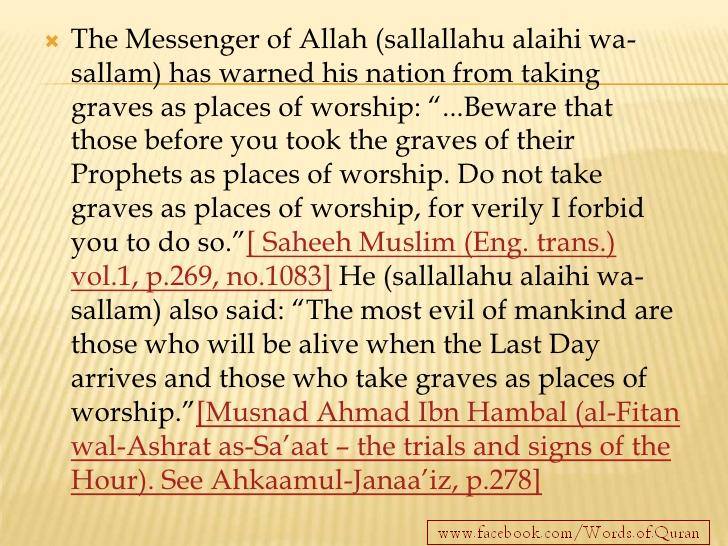
Jundab said: Five days before he died, I heard the Prophet (PBUH) say, “I declare before Allah that I do not have a Khalil (a close friend) among you, for Allah has taken me as a close friend. If I were to take a close friend from among you, I would have taken Abu Bakr (RA) as a close friend. Those who came before you used to take the graves of their Prophets & righteous men as Masjids (places of worship & prayer); do not take graves as Masjids, I forbid you to do that.”
(Hadith No. 1188 (532), Book of Masajid & Places of Prayer, Sahih Muslim, Vol. 2).
Isn’t the message clear? Our beloved Prophet (PBUH) was concerned about this thing even at the time of his death. Just give it a thought: a person nearing his/her death shows concern about really serious issues. Dear brothers and sisters, all this is prohibited in Islam, even building a mosque on a grave is not allowed.
Allah’s Messenger (PBUH) has used very strong words for people who make Masjids on graves. Refer to following hadith:
It was narrated from Aishah (RA) that the Prophet (PBUH) said, “May Allah curse people who take the graves of their prophets as Masjids.”
(Hadith No. 2048, Book of Funerals, Sunan An-Nasa’i, Vol. 3).
Allah’s Messenger (PBUH) compares such people to Jews and Christians who used to take graves of their righteous men as places of worship and considers them as the worst people on the earth. And Aishah (RA) said that were it not for that, his grave would have been in an open place, but he feared that it would be taken as a place of worship (reported by Bukhari & Muslim).
All these rulings about graves and graveyards make everything absolutely clear for us. And these should be enough to stop people from going to graves for doing various innovative acts (which have nothing to do with Islam). But no, the things do not stop here. This was only the first step we discussed. This has led to so many other acts which are absolutely wrong as per Islam. But the supporters of these acts have several explanations in their support.
Let us talk about these things and the explanations (or excuses rather) put forward by the doers in their defence.
Point No. 1. Praying for the dead (the one buried in the grave)
People go to the graves and pray for the dead. There is no harm in that. But it has to be according to the correct procedure, as told to us by our beloved Prophet (PBUH). Going to graves of fellow Muslims and praying for their Maghfirah is recommended. This is what is prayed in Salat-al-Janazah and this is what has been discussed in earlier sections of this discussion. The problem starts when people cross the limits prescribed in Islam for such things. People prepare food, distribute it to the people who come to the tombs of the dead and feel that they can pass on the benefits of this to the deceased. It is absolutely wrong and a Bida’a. I wish to draw the attention of readers to the following hadith:
It was narrated from Abu Hurairah (RA) that Allah’s Messenger (PBUH) said, “When a man (or a woman) dies, all his/her good deeds come to an end, except three: a) Ongoing charity done by the deceased (Sadaqa-e-Jaariya)…b) Beneficial knowledge of the deceased that will keep on helping the others.…..and third….c) Righteous son/daughter who will pray for him/her (the deceased).”
(Hadith No. 4223 (1631), Book of Wills, Sahih Muslim, Vol. 4).
Therefore, no one can benefit the dead person, except the three things mentioned above. Some may argue that then how can we accept praying for maghfirah of the dead. The answer is very simple. First thing is that it has been told by Allah’s Messenger (PBUH), so it is better not to argue about this. But there is a logical explanation for this. When we pray to Allah for maghfirah of the dead (or alive), we know that it is up to The Almighty to accept the prayer or not. However, when we ascribe acts of Bida’a (like making food, distributing it to other people and sending the sawaab to the dead), it gives us a sense of assurance that the sawaab has been credited in the account of the dead. This is illogical. This is against Islam.
Point No. 2. Praying to the dead; the concept of Waseelah
This is the core of our discussion here: The concept of Waseelah. People pray on graves of some righteous men with an intention of getting benefits by means of that.
Few months back, I read in a Hindi newspaper that three big position-holders of a particular city in India – Imam, Mufti, & Qazi – addressed the public and emphasized that the city they all live in is the city of righteous men who are buried in different tombs all across the city, and the people of the city get lot of benefits from these pious men buried in the graves. So the people should not listen to others who brand these acts of constructing tombs, praying on tombs etc. as wrong in Islam, and keep doing what they are doing for ages.
What to say about such scholars? The statement that people get benefit from these righteous men buried in their graves needs to be picked for special consideration in this section. This act is an act of Shirk. Expecting benefits from the dead, or as a matter of fact from anyone other than Allah, is Shirk. It is not allowed to invoke anyone other than Allah. Refer to following verse of Qur’an:
وَأَنَّ الْمَسَاجِدَ لِلَّهِ فَلا تَدْعُوا مَعَ اللَّهِ أَحَداً
“And the masjids are for Allah (Alone); so invoke not anyone along with Allah.”
(Aayah No. 18, Surah Al-Jinn, Chapter No. 72, Holy Qur’an).
Clearly, it is not allowed to invoke anyone other than Allah. He commands His servants to single Him out alone for worship and that none should be supplicated to along with Him. Thus, praying to the dead (on the graves) with an intention of getting any benefit is clear Shirk.
Don’t these scholars know about this verse of Qur’an? They know, for sure they know, but they have some excuses, accompanied with explanations which are wrong. Let us take these wrong explanations one-by-one.
Point No. 2.1. They say that actually they do not pray to the dead, but seek their Waseelah to achieve success.
According to them, Islam recommends its followers to seek Waseelah of righteous people to get the prayers fulfilled and to achieve success in the life and Hereafter. It is absolutely wrong. They quote a verse of Qur’an in support of Waseelah, but I am so sorry to say that the verse has been misinterpreted. Let me explain about it.
يَا أَيُّهَا الَّذِينَ آمَنُوا اتَّقُوا اللَّهَ وَابْتَغُوا إِلَيْهِ الْوَسِيلَةَ وَجَاهِدُوا فِي سَبِيلِهِ لَعَلَّكُمْ تُفْلِحُونَ
“O you who believe! Do your duty to Allah & fear Him. And seek the Waseelah to Him, and strive hard in His cause, so that you may be successful.”
(Aayah No. 35, Surah Al-Ma’idah, Chapter No. 5, Holy Qur’an).
This verse asks us to seek Waseelah to Allah, but the interpretation of this verse has not been taken correctly by Urdu speaking scholars. In Urdu language, Waseelah means zariya, and it has been taken as a recommendation to take some righteous people who are already dead as zariya of achieving falah. How far-fetched is the ideology; absolutely against the concept of Islamic Monotheism! Our Urdu loving brothers and sisters should not forget that the language of Qur’an is Arabic. So, let us keep Urdu at bay and understand the meaning of Waseelah in context of Arabic language.
Here is the correct explanation of the term Waseelah:
Seeking Waseelah means ‘to seek the proximity & closeness to Allah, to seek means of getting close to Allah by obeying him and performing the acts that please Him‘. This is clear from the above mentioned aayah itself, as it asks us to seek Waseelah to Allah, followed by the command to strive in Allah’s cause in order to be successful. It is absolutely clear.
Waseelah also means or refers to the highest grade in Paradise, as is evident from following narrations:
It was narrated that Jabir (RA) said: Allah’s Messenger (PBUH) said, “Whoever says, when he hears the call to prayer (i.e. Adhan): Allahumma rabba hadhi-hid-dawat it-ta’mmah wa-salat-il-qa’imah aati Muhammadan al-wasilah wa-al-fadilah, wab’athu maqaman mahmuda al-ladhi wa’adthu, will be granted my intercession on the Day of Resurrection.”
(Hadith No. 681, Book of Adhan, Sunan An-Nasa’i, Vol. 1).
Meaning of this dua is: O Allah, Lord of this perfect call and prayer to be offered, grant Muhammad (PBUH) the privilege and also the eminence and resurrect him to the praised position that you have promised. Regular recitation of this dua after each Adhan ensures that our beloved Prophet (PBUH) intercedes for forgiveness of our sins on the Day of Judgement, Be-izn-Allah.
This is explained beautifully in another narration from Sahih Muslim.
It was narrated from Abdullah bin Amr bin Al Aas (RA) that he heard the Prophet (PBUH) say, “When you hear the Muadhdhin, say what he says, then send Salat upon me, Allah will send Salat upon him tenfold. Then ask Allah to grant me Al-Waseelah, for it is a station in Paradise which only one of the slaves of Allah will attain, and I hope that I will be the one. Whoever asks for Al-Waseelah for me, (my) intercession will be permissible for him.”
(Hadith No. 849 (384), Book of As-Salat, Sahih Muslim, Vol. 1).
These narrations make everything crystal clear. The Waseelah mentioned in the above mentioned aayah of Surah Al-Ma’idah has been mis-interpreted by Urdu scholars, which has led to lot of misguidance.
The fact is that we are not supposed to invoke anyone else other than Allah; it is absolutely wrong to invoke any dead person with an intention of achieving success or getting the things done (through their version of Waseelah). It is Shirk to do so.
However, the narrations mentioned above tell us that Muslims shall benefit from the intercession of Allah’s Messenger (PBUH) on the ‘Day of Judgement’ in accordance with the conditions associated with it, Be-izn-Allah. Here, I wish to clarify that intercession is a totally different thing and Insha’Allah we shall talk about it in detail towards the end of this section.
I hope this clarifies the myth surrounding the concept of Waseelah. I request the people to understand this clearly, with a special request to Urdu speaking scholars to open their minds for proper understanding of the subject.
Point No. 2.2. Seeking Waseelah of a righteous person is similar to putting forward our case in a court, for which a lawyer is required.
They say that (their concept of) Waseelah of righteous men is similar to a lawyer presenting and fighting their case in a court. It is again an absurd excuse. In normal courts, we need a lawyer to present our case to the judge. Here the judge is not aware of the facts, about who is right or who is wrong, and his judgement is based on the facts put forward by lawyers of the parties in court. It is very foolish on our part to compare this with the court of Allah. Allah is All-Knower; there is no one who knows better than Him.
This should be understood from another angle also. A person who fights a case in court hires a lawyer to help him/her in the case, to take care of his/her affairs related to the case. But when it comes to invoking Allah for our needs, we do not need any lawyer or Wakil (as said in Urdu language) to help us. Allah is our Wakil; He (Alone) is our Helper, our Protector. Allah says:
أَلاَّ تَتَّخِذُوا مِنْ دُونِي وَكِيلاً
“Take none other than Me as (your) Wakil (Protector, Lord or Disposer of affairs).”
(Aayah No. 2, Surah Al-Isra’, Chapter No. 17, Holy Qur’an).
Therefore, this excuse of considering these righteous people buried in graves as Wakils (i.e. lawyers in English) is against Islam; leading to Shirk.
Point No. 2.3. Considering these righteous people (buried in graves) as alive; not like ordinary dead people
Another excuse put forward in support of seeking (their version of) Waseelah of the dead righteous men is that these men are not like normal dead people. Two different ideologies exist related to this. Let us talk about both one-by-one.
First ideology is that these righteous people who are buried in their graves are not like normal dead people, but they are martyrs in the cause of Allah, and they are not supposed to be called dead. Following verse from Qur’an is quoted by the people who support this ideology:
وَلا تَقُولُوا لِمَنْ يُقْتَلُ فِي سَبِيلِ اللَّهِ أَمْوَاتٌ بَلْ أَحْيَاءٌ وَلَكِنْ لا تَشْعُرُونَ
“And say not of those who are killed in the Way of Allah, ‘They are dead‘. Nay, they are living, but you perceive not.”
(Aayah No. 154, Surah Al-Baqarah, Chapter No. 2, Holy Qur’an).
True; martyrs are not like other dead people. Their status is much greater than others. But that also needs to be understood correctly by us, so as not to enter any act of Shirk. Refer to following verses of Qur’an:
وَلا تَحْسَبَنَّ الَّذِينَ قُتِلُوا فِي سَبِيلِ اللَّهِ أَمْوَاتاً بَلْ أَحْيَاءٌ عِنْدَ رَبِّهِمْ يُرْزَقُونَ
“Think not of those who are killed in the Way of Allah as dead. Nay, they are alive, with their Lord, and they have provision.”
فَرِحِينَ بِمَا آتَاهُمْ اللَّهُ مِنْ فَضْلِهِ وَيَسْتَبْشِرُونَ بِالَّذِينَ لَمْ يَلْحَقُوا بِهِمْ مِنْ خَلْفِهِمْ أَلاَّ خَوْفٌ عَلَيْهِمْ وَلا هُمْ يَحْزَنُونَ
“They rejoice in what Allah has bestowed upon them of His Bounty and rejoice for the sake of those who have not yet joined them, but are left behind that on them no fear shall come, nor shall they grieve.”
يَسْتَبْشِرُونَ بِنِعْمَةٍ مِنْ اللَّهِ وَفَضْلٍ وَأَنَّ اللَّهَ لا يُضِيعُ أَجْرَ الْمُؤْمِنِينَ
“They rejoice in a Grace and a Bounty from Allah, and that Allah will not waste the reward of the believers.”
(Aayah No’s 169, 170 & 171, Surah Aal-Imran, Chapter No. 3, Holy Qur’an).
I shall Insha’Allah try to explain these verses by references of authentic ahadith, which will help us understand them the way our Prophet (PBUH) and his companions understood them. Go through following narration:
It was narrated that Masruq said: We asked Abdullah bin Masoud (RA) about this verse: ‘Think not of those who are killed in the Way of Allah as dead. Nay, they are alive, with their Lord, and they have provision.’ He said: We also asked about that and he (the Prophet, PBUH) said, “Their souls are in crops of green birds, which have lamps hanging from the Throne, and they roam freely wherever they want in Paradise, then they return to those lamps. Their Lord looked down upon them and said: ‘Do you desire anything?’ They said: ‘What could we desire, when we can roam freely wherever we want in Paradise?’ He did that with them three times, and when they saw that they would not be left without being asked, they said: ‘O Lord, we want You to restore our souls to our bodies so that we may be killed in Your cause again.’ When He saw that they had no need, they were left alone.”
(Hadith No. 4885 (1887), Book of Leadership, Sahih Muslim, Vol. 5).
In another narration, Imam Ahmad records that Ibn Abbas (RA) said that Allah’s Messenger said, “The martyrs convene at the shore of a river close to the door of Paradise, in a green tent, where their provisions are brought to them from Paradise day & night.”
After going through these narrations, it appears that martyrs are of different types, some of them wander in Paradise, and some remain close to this river by the door of the Paradise.
Coming back to the status of martyrs in the cause of Allah, it should be known that their status is much above the ordinary dead people. One reason is that the moment they die as a martyr, all their sins are forgiven and they are taken directly to Paradise, whereas all others have to go through the Judgement before going to Paradise. There is no Judgement for a martyr (except in case of debt or an unfulfilled oath, which we shall discuss in a separate discussion some other time, Insha’Allah). This makes them superior in grade to others.
This explains about not to call them dead (like other dead people).
Now, even if all those righteous people buried in their graves (tombs and places of worship constructed on their graves) are martyrs, thereby implying that they are alive in the sense we have tried to understand the verses of Qur’an related to this above, how do we proclaim that they can be of any benefit to us? I have not come across any verse in Qur’an or any hadith which tells us this. This belief is a classic case of transgression; not allowed in Islam.
Let us come to the second ideology in this context. Some people go on to the extremes by saying that all these great people are not dead but alive. Now they are not talking about them being martyrs or not, instead they claim that these great people (including the Prophet, PBUH) are not dead at all, they are alive and listen to all our calls, though we cannot see them.
Now, whoever believes in this ideology is surely in error. Such a belief is against Qur’an. Allah says:
كُلُّ نَفْسٍ ذَائِقَةُ الْمَوْتِ
“Everyone has to taste death”
(Aayah No. 35, Surah Al-Anbiya, Chapter No. 21, Holy Qur’an).
Allah makes it clear that every living soul has to die. Isa (AS) was taken away from the earth, and Muslims belief is that he shall be sent again on earth before Qayamah, and then he will die like every other human. There is no exception at all. If someone tries to make an exception for Muhammad (PBUH), he/she should refer to following verses of Qur’an:
إِنَّكَ مَيِّتٌ وَإِنَّهُمْ مَيِّتُونَ
“Verily, you (O’ Muhammad) will die and verily, they (too) will die.”
(Aayah No. 30, Surah Az-Zumar, Chapter No. 39, Holy Qur’an).
and,
وَمَا مُحَمَّدٌ إِلاَّ رَسُولٌ قَدْ خَلَتْ مِنْ قَبْلِهِ الرُّسُلُ أَفَإِيْن مَاتَ أَوْ قُتِلَ انْقَلَبْتُمْ عَلَى أَعْقَابِكُمْ وَمَنْ يَنْقَلِبْ عَلَى عَقِبَيْهِ فَلَنْ يَضُرَّ اللَّهَ شَيْئاً وَسَيَجْزِي اللَّهُ الشَّاكِرِينَ
“Muhammad (PBUH) is no more than a Messenger, and indeed Messengers have passed away before him. If he dies or is killed, will you then turn back on your heels? And he who turns back on his heels, not the least harm will he do to Allah, and Allah will give reward to those who are grateful.”
(Aayah No. 144, Surah Aal-Imran, Chapter No. 3, Holy Qur’an).
The above mentioned verse is the one which Abu Bakr (RA) recited to calm down the people at the time of death of Allah’s Messenger (PBUH), as the people were not believing that the Prophet (PBUH) had died. He said to all: Whoever worshipped Muhammad (PBUH), then Muhammad (PBUH) is dead. But whoever worshipped Allah, Allah is alive and will never die.
The details of death of our beloved Prophet (PBUH) can be found in collections of ahadith (refer to ahadith by Imam Tirmidhi and book on Prophet’s Seerah by Imam Ibn Kathir).
I hope the explanation clarifies the doubts.
Therefore, praying to the dead on their graves to seek benefits through them is haraam; whether we consider them as martyrs or we consider them as alive. Either way, it is against Islam.
Point No. 2.4. Believing that these righteous people can hear from the graves
Before proceeding further, let me quote a hadith:
It was narrated from Anas (RA) that the Prophet (PBUH) said, “When a person is placed in his grave and his companions depart from him, he hears the sound of their sandals (i.e. the footsteps).”
(Hadith No. 2051, Book of Funerals, Sunan An-Nasa’i, Vol. 3).
Similar narration has been reported by Bukhari as well. We see that every person who is buried after his/her death hears the sounds of outer world. Moreover, every dead person is shown his/her place, either in Paradise or Hell, the moment he/she is buried and the questioning in grave starts. So every dead can see also up to this extent. To put a final seal on the matter, let us go through the following hadith:
Narrated Ibn Umar (RA): The Prophet (PBUH) looked at the dead people of the well (the well in which there were dead bodies of Mushriks killed during the Battle of Badr) and said, “Have you found true what your Lord promised you?” Somebody said to him, “You are addressing dead people.” He replied, “You do not hear better than they, but they cannot reply.”
(Hadith No. 1370, Book of Funerals, Sahih Bukhari, Vol. 2).
Thus, if we talk about hearing of the dead from graves, even non-believers can hear. Where does this lead us to?
Point No. 2.5. They say that the Prophet (PBUH) and these righteous people have the knowledge of the unseen (i.e. the Ghaib).
This is yet another wrong belief. Refer to what Qur’an says about this matter:
عَالِمُ الْغَيْبِ فَلا يُظْهِرُ عَلَى غَيْبِهِ أَحَداً
“The All-Knower of the Unseen, and He reveals to none His Unseen,”
إِلاَّ مَنْ ارْتَضَى مِنْ رَسُولٍ فَإِنَّهُ يَسْلُكُ مِنْ بَيْنِ يَدَيْهِ وَمِنْ خَلْفِهِ رَصَداً
“Except to a Messenger whom He has chosen, and then He makes a band of watching guards to march before him and behind him.”
(Aayah No’s 26 & 27, Surah Al-Jinn, Chapter No. 72, Holy Qur’an).
Allah states very clearly that only He knows the unseen and the seen, and that no one of His creation can attain any of His knowledge except that which Allah allows him to have. Whatever knowledge was with the Prophet (PBUH) was granted to him by Allah as per His will and angels were appointed to guard and protect the knowledge of Allah with the Prophet (PBUH).
Therefore, whoever believes that the Prophet (PBUH) or any other righteous person of their choice has the knowledge of the Ghaib, is wrong, mistaken and committing a grave sin by believing so.
Point No. 2.6. They quote a hadith to prove that companions of the Prophet (PBUH) resorted to Waseelah for getting their prayers answered by Allah.
Some time back, I was watching one scholar from Pakistan talking about this. He was addressing a group of women who seemed to have asked him about the proof in ahadith about any of the companions of the Prophet (PBUH) resorting to (their version of) Waseelah of any one to get their prayers answered by Allah. This gentleman was seated in a chair, surrounded by books of all types and was using beautiful vocabulary to make his words appear meaningful. He asked one of his assistants to hand him over a book. Then taking the book in his right hand he stated that it was Sahih Bukhari, and asked the listeners to go to the ‘Book of Al-Istisqa’. Out of it, he read out a hadith in Urdu language. After completing the hadith, he had a sense of satisfaction of convincing the listeners of his stance that the companions of the Prophet (PBUH) resorted to Waseelah of others for getting their prayers answered by Allah.
Let us see this hadith:
Narrated Anas (RA): Whenever drought threatened them, Umar bin Al-Khattab (RA) used to ask Al Abbas bin Abdul Muttalib to invoke Allah for rain. He used to say, “O Allah! We used to ask our Prophet (PBUH) to invoke You for the rain, and You would bless us with rain, and now we ask his uncle to invoke You for rain. O Allah! Bless us with rain.” And so it would rain.
(Hadith No. 1010, Book of Al-Istisqa, Sahih Bukhari, Vol. 2).
This hadith tells us that it is permissible for one to request another living person to invoke (pray to) Allah on his/her behalf; that’s all. For e.g.: when we meet our relatives or friends etc., we can ask them to remember us in their prayers… it is very common to say so. But this hadith does not give any message or permission that allows us to invoke Allah through dead; does it?
The hadith mentioned here and most widely used by supporters of Waseelah has got nothing to do with their claims. These scholars should fear Allah; they should stop misguiding people.
Point No. 2.7. Intercession (Shafa’at)
People often take Waseelah and Shafa’at as similar things; it is a major misunderstanding that prevails among Muslims of Indian sub-continent (India, Pakistan, Bangladesh etc.). In fact, the two things are entirely different. I have already clarified the concept of Waseelah in our discussion here above. Now let me clarify what is meant by Shafa’at from Islamic point of view.
Shafa’at (or Intercession) has been a matter of controversy for a long time now among different schools of thoughts. As should be the case always, let us try to erase all doubts about the matter and unify our understanding based on Qur’an and Ahadith
Intercession (or Shafa’at) belongs to Allah alone.
قُلْ لِلَّهِ الشَّفَاعَةُ جَمِيعاً لَهُ مُلْكُ السَّمَوَاتِ وَالأَرْضِ ثُمَّ إِلَيْهِ تُرْجَعُونَ
“Say: To Allah belongs all intercession. His is the sovereignty of the heavens and the earth, then to Him you shall be brought back.”
(Aayah No. 44, Surah Az-Zumar, Chapter No. 39, Holy Qur’an).
In this verse, Allah condemns the idolators who used to take their idols as intercessors besides Allah on the basis of their own whims, with no evidence and proof. Just like the dominion and sovereignty belongs to Allah alone, similarly, intercession belongs to Allah alone. So, it is not correct to say that any personality has the authority/ability/status to intercede for us in front of Allah.
This shall get more clarified when we discuss other aspects of intercession.
Allah gives permission for some to intercede.
يَوْمَئِذٍ لا تَنفَعُ الشَّفَاعَةُ إِلاَّ مَنْ أَذِنَ لَهُ الرَّحْمَنُ وَرَضِيَ لَهُ قَوْلاً
“On that day no intercession shall avail, except the one for whom the Most Gracious has given permission and whose word is acceptable to Him.”
(Aayah No. 109, Surah Ta’Ha, Chapter No. 20, Holy Qur’an).
So we see that Allah grants permission to some and accepts their intercession on the ‘Day of Judgement’.
The Prophet (PBUH) tops the list of such who are granted permission from Allah to intercede for others. He will be the first one for whom the earth will be opened and he will come forth to the gathering place. He will have a banner under which Adam (AS) and everyone else will gather. He will have the right to ‘Grand Intercession’ with Allah when He comes to judge between His creation. There is a lengthy hadith (Hadith No. 7510, Book of Tauhid, Sahih Bukhari, Vol. 9) of Anas (RA), narrated by Ma’bad bin Hilal Al Anazi, about intercession of the Prophet (PBUH). Mentioning the whole hadith here will occupy a lot of space. However, I am quoting a smaller hadith which tells us about the intercession of Prophet Muhamamd (PBUH) for his Ummah. Refer to the narration below:
Narrated Anas (RA): I heard the Prophet (PBUH) saying, “On the Day of Resurrection I will intercede and say: O my Lord! Admit into Paradise (even) those who have faith equal to a mustard seed in their hearts. Such people will enter Paradise, and then I will say: (O Allah!) Admit into Paradise (even) those who have the least amount of faith in their hearts.” Anas (RA) then said, “As if I were just now looking at the fingers of Allah’s Messenger (PBUH).”
(Hadith No. 7509, Book of Tauhid, Sahih Bukhari, Vol. 9).
Apart from the Prophet (PBUH), the angels as well as other people can also be allowed to intercede on behalf of others as per Allah’s permission. Following references prove this:
وَكَمْ مِنْ مَلَكٍ فِي السَّمَوَات
لا تُغْنِي شَفَاعَتُهُمْ شَيْئاً إِلاَّ مِنْ بَعْدِ أَنْ يَأْذَنَ اللَّهُ لِمَنْ يَشَاءُ وَيَرْضَى
“And there are many angels in the heavens, whose intercession will avail nothing except after Allah has given leave for whom He wills and is pleased with.”
(Aayah No. 26, Surah An-Najm, Chapter No. 53, Holy Qur’an).
and,
Aishah (RA) narrated that the Prophet (PBUH) said, “No one among the Muslims dies, and Salat is performed for him by a community of Muslims reaching one hundred, and they intercede (supplicate) for him, except that their intercession for him is accepted.” In his narration, Ali bin Hujr said, “One hundred or more than that.”
(Hadith No. 1029, Chapters on Janaiz, Jami’ At-Tirmidhi, Vol. 2; Hadith No. 2198 (947), Book of Funerals, Sahih Muslim, Vol. 2; Hadith No. 1994, Book of Funerals, Sunan An-Nasa’i, Vol. 3).
However, this intercession is not what we have talked about the ‘Grand Intercession’ of Prophet Muhammad (PBUH).
No one can intercede for anyone without permission of Allah.
مَنْ ذَا الَّذِي يَشْفَعُ عِنْدَهُ إِلاَّ بِإِذْنِهِ
“Who is he that can intercede with him except with His permission?”
(Aayah No. 255, Surah Al-Baqarah, Chapter No. 2, Holy Qur’an).
This verse asserts Allah’s greatness, pride and grace, and that no one dares to intercede with Him on behalf of anyone else, except by His permission. Therefore, even though we learn that Prophets, angels and other people shall be interceding on behalf of others on the ‘Day of Judgement’, we should understand that that shall be done only because Allah allows them to intercede. Without Allah’s permission, no one can intercede on anyone’s behalf. There should be no doubt in our minds regarding this fact.
Intercession (or Shafa’at) is a thing that shall take place in the Hereafter (on the ‘Day of Judgement’).
We have read narrations about intercession on the ‘Day of Judgement’. Based on all such explanations, we should understand clearly that the concept of intercession is for the ‘Day of Judgement’. There is no concept of such intercession in this world.
When talked about intercession in this world, it has a limited meaning that has got nothing to do with benefitting the others in terms of their fate in the Hereafter. For example: If we see someone doing anything wrong, we intercede and try to advise him to refrain from wrong deed. Or if we meet our close ones, we may say phrases like Please pray for us. Or people in authority on earth can change their decisions in favour of others on request by others. These are the types of intercessions which take place in this world. Such intercessions are limited to this world only. But please remember that even outcomes of such intercessions depend on Allah’s will; nothing can happen without permission of Allah.
I hope we all are clear about the matter of Shafa’at by now.
Point No. 3. Doing prostrations on graves
Prostrating before anyone other than Allah is not allowed in Islam. But the people who do prostrations on graves of their beloved righteous dead men have an excuse. They say that it is not a normal prostration (which is done for Allah), rather they do prostrations of respect. They quote example of parents & brothers of Yusuf (AS) who prostrated before Yusuf (AS) as a mark of respect.
Let us understand this concept clearly. Aayah No. 100 of Surah Yusuf (Chapter No. 12, Holy Qur’an) tells us that Yusuf’s (AS) parents and brothers prostrated before him. In the laws of these and previous Prophets, it was allowed for the people to prostrate before the men of authority, when they met them. This practice was allowed in the law of Adam (AS) until the law of Isa (AS), but was later prohibited in our law. Let me quote a narration to explain this.
Qais bin Sa’d said: I visited Al-Hirah, and saw that its inhabitants would prostrate to their nobles. I said (to myself), ‘Allah’s Messenger (PBUH) has more right that (people) prostrate to him.’ So I returned to the prophet (PBUH) & said, ‘I visited Al-Hirah, and saw that its inhabitants would prostrate to their nobles. And you, O Allah’s Messenger (PBUH), have more right that we prostrate to you.’ He replied, “I ask you, if you passed by my grave, would you prostrate to it?” I replied, “No.” He replied, “Then don’t do so! Were I to command any person to prostrate to another, I would have commanded the women to prostrate to their husbands, due to the rights that Allah has given them over their wives.”
(Hadith No. 2140, Book of Marriage, Sunan Abu Dawud, Vol. 2).
Narration similar to the later part of the above mentioned hadith has also been reported by Tirmidhi in his Jami’, under Chapters on Suckling (Hadith No. 1159), on the authority of Abu Hurairah (RA).
This narration is a proof that, according to Islamic Shariah, prostration to anyone other than Allah is prohibited. Even the prostration of respect is not allowed. Had the prostration of respect been lawful, the Prophet (PBUH) would have ordered the wife to prostrate to her husband.
If we read the hadith carefully, we can see that there is a clear ‘No’ for prostrating even on the Prophet’s (PBUH) grave.
I don’t think this needs any further clarification.
Point No. 4. Singing songs, qawwalis etc. and playing musical instruments on the graves
Another common feature of the tombs is that people are seen singing qawwalis, songs etc. in praise of the people buried there. In some places men can be seen dancing also to the tunes of musical instruments played there. When asked about the reason of all that, they say that it is their love for the person buried there which they are expressing in the form of songs etc.
Now someone should ask them, that in order to express your love for the people who are already dead, you are taking music as the means to do so. Music is allowed in Islam for certain occasions, but in no way can it be used as a medium of worship of any kind; it is a disliked thing after all. Apart from this, they should spare a thought to the nuisance they create in their surroundings by shouting songs and qawwalis on high decibel levels and giving a big headache to the neighbours, sometimes even giving them sleepless nights.
This act has been adopted from Hindu culture. Hindus have a tradition of singing hymns and songs (known as bhajans) to please their so-called gods and goddesses.
It is a big shame on Muslims who indulge in such activities.
Point No. 5. Doing gatherings on an annual basis in the form of Urs
It is a common feature in Indian sub-continent that caretakers of some famous tombs organize annual gatherings on the tombs. These gatherings are termed as Urs in Urdu language. Some famous tombs known for their gatherings are: Nizamuddin in Delhi (India), Moinuddin Chishti in Ajmer (India), Syed Ali Hijveri in Lahore (Pakistan) etc. There are lot more other tombs, but I do not remember their names correctly. People gather at these places during Urs time from all the corners of the world, with an intention of seeking blessings from the righteous people buried there. Money is spent in millions on acts and traditions which find no authenticity in Islam. Just imagine how much the real needy people can benefit from all the money that is wasted on these tombs, which ultimately find its way into the vaults of these caretakers.
Businesses thrive on these gatherings. Many people are duped of their money. The caretakers have their own say in the matters of the tombs. They have their own system, and no outsider can dare to challenge them or any of their acts.
Earlier this practice was restricted to bigger tombs, but now it can be seen on every small grave here and there.
Please try to understand that all this is against Islam, these are acts of Bida’a. They lead to violation of many Islamic principles. Israf, Exploitation, Illegal earnings, Bida’a & Shirk, all these can be seen in abundance at these gatherings.
Point No. 6. Considering these as righteous acts which pave the way for Falah
We have seen in our discussion that all these acts are acts of Bida’a & Shirk. How can someone depend on such things for getting a place in Paradise? Allah has clearly mentioned the criterion of entry to Paradise in Qur’an. And the fact is that even after complying with all what Allah wants us to do; we depend on His Mercy & Grace to gain entry to Paradise. Let us study a hadith on this subject:
Narrated Aishah (RA): The Prophet (PBUH) said, “Do good deeds properly, sincerely and moderately, and receive good news because one’s good deeds will not make him enter Paradise.” They asked, “Even you, O Allah’s Messenger (PBUH)?” he said, “Even I, unless & until Allah protects or covers me with His Pardon and Mercy.”
(Hadith No. 6467, Book of Ar-Riqaq, Sahih Bukhari, Vol. 8).
Similar narration through Abu Hurairah (RA) has also been reported by Bukhari. Give this hadith a deep thought. When the Prophet (PBUH), who has been the greatest man on the earth ever, for whom is the greatest reward in the Hereafter, he says about himself that his entry into Paradise also depends on Allah’s mercy; then where do we stand? And on what basis can someone say that the righteous men buried in the graves can help anyone achieve Falah? They themselves depend on Allah’s mercy, as does everyone else. That’s why every Muslim is supposed to pray for Maghfirah for all other fellow Muslims, alive or dead.
Point No. 7. Is it not even allowed to pray to Allah’s Messenger (PBUH) & seek his (so-called) Waseelah for getting the prayers answered by Allah or for achieving success?
Refer to following verse of Qur’an:
وَإِذَا سَأَلَكَ عِبَادِي عَنِّي فَإِنِّي قَرِيبٌ أُجِيبُ دَعْوَةَ الدَّاعِي إِذَا دَعَانِي فَلْيَسْتَجِيبُوا لِي وَلْيُؤْمِنُوا بِي لَعَلَّهُمْ يَرْشُدُونَ
“And when My slaves ask you (O Muhammad, PBUH) concerning Me, then (tell them) I am indeed near. I respond to the invocations of the supplicant when he calls on Me. So let them obey Me & believe in Me, so that they may be led right.”
(Aayah No. 186, Surah Al-Baqarah, Chapter No. 2, Holy Qur’an).
This aayah tells us clearly that Allah wants His servants to invoke Him directly. It is not allowed to invoke even Allah’s Messenger (PBUH) or to seek his (so-called) Waseelah for getting our prayers answered. It is only Allah to whom we ask for all our needs. And He has promised that He shall respond to the call of the one who invokes Him.
Refer to following verse:
وَقَالَ رَبُّكُمْ ادْعُونِي أَسْتَجِبْ لَكُمْ
“And your Lord said: Invoke me, I will respond to your (invocation).”
(Aayah No. 60, Surah Ghafir, Chapter No. 40, Holy Qur’an).
#Concluding Remarks
All the references from Qur’an and authentic narrations of our beloved Prophet’s (PBUH) sayings leave no doubts about the outcome of our discussion. Let me summarize the inference:
Apart from funerals, going to graves/graveyards is allowed only for the purpose of praying for Maghfirah of the dead as well as oneself, and to be reminded of the Hereafter. For women, the ruling is even stricter.
Making the graves high and beautifying them is prohibited in Islam.
Building structures (even places of worship like Masjids) on the graves is prohibited in Islam.
Doing acts of worship on graves (like prostrations, invocations etc.) are prohibited in Islam.
Organizing fairs etc. (like Urs) on graves is a Bida’a.
Invoking anyone other than Allah, dead or alive (howsoever righteous he/she might have been in his /her life), with an intention of getting benefit through them is Shirk. It is not allowed to pray to Allah’s Messenger (PBUH) even.
In general, majority of the people have adopted a wrong concept of Waseelah & Shafa’at; the explanations they provide to support their understanding are wrong; and the corresponding acts lead to Bida’a & Shirk. Please read the explanations for the same provided in this article in light of Qur’an and Sunnah for proper understanding.
Several of these wrong customs have been taken from Hindu culture. Isn’t it a matter of shame that instead of impressing the non-believers with the teachings of Islam and inviting them to this beautiful religion, some of us tend to get impressed with their traditions and adopt them as a part of our religion? Hindus now openly say: What is the difference between us? We worship the idols; you worship graves. We sing hymns in praise of our gods and goddesses; you sing qawwalis and songs in praise of your deceased ones. We distribute sweets and other food items as Prasad; so do you now. Then why do you call us non-believers and yourselves as believers? This is what the Hindus have started asking now. I request my Muslim brothers and sisters not to do any act that gives non-believers a chance to point out fingers on Islam.
Please remember that we are Muslims and the foundation of our belief is Tauheed. We believe in Qur’an as the guidance for us. And the starting Chapter of Qur’an tells us:
إِيَّاكَ نَعْبُدُ وَإِيَّاكَ نَسْتَعِينُ
“You (Alone) we worship, and You (Alone) we ask for help.”
(Aayah No. 5, Surah Al-Fatiha, Chapter No. 1, Holy Qur’an).
Whoever recites this verse regularly (in five daily prayers) should know that by reciting these words he/she is affirming that he/she asks Allah (Alone) for help and no one else. Then how can someone advocate the wrong concepts of Waseelah or Shafa’at in this world and praying to dead etc.
Please stay away from these acts of Shirk and Bida’a.
And Allah knows best.
May Allah forgive me if I am wrong and guide us to the right path…Ameen.
.سُبْحَانَ رَبِّكَ رَبِّ الْعِزَّةِ عَمَّا يَصِفُون َ ; وَسَلامٌ عَلَى الْمُرْسَلِينَ ; وَالْحَمْدُ لِلَّهِ رَبِّ الْعَالَمِينَ
---------------------------------------------------------------------------------
Please: Like ✔Follow ✔Join ✔Share ✔ & Invite Your Friends ✔
---------------------------------------------------------------------------------
Page Link: https://www.facebook.com/Words.of.Quran
Group Link: https://www.facebook.com/groups/words.of.quran/
Blog Link: http://wordsofquran13.blogspot.ae/
May Allah Reward you all In this World and the Here After....
Jazakumullahu Khairan.
Share: Praying on Graves; Waseelah; Shafa’at etc. – Right or Wrong?